
Seagate Perspectives · Sustainability Report
Decarbonizing Data: Seagate’s data center sustainability report
Authorized Reseller · Enterprise Pricing · Lifecycle Support
Strategic considerations for data center sustainability in the AI era. A Seagate Technology report — with research by Dynata and fieldwork by Current Global — on the AI-intensified strain on data center sustainability, and the opportunities for increasing the efficiency of operations.
reported that their companies face increasing data storage needs
anticipate AI's growth to further impact storage demand
total reduction in energy consumption by storage infrastructure via higher-density HAMR drives
projected share of global carbon emissions from data centers, up from 0.3% in 2022 (IEEE)
Why does data center sustainability matter in the AI era?
As widespread adoption of data-intensive artificial intelligence (AI) technologies speeds up worldwide, data center operations are facing unprecedented energy demands and a growing carbon footprint. They are grappling with escalating environmental concerns while also striving to scale compute power and storage capacity and to meet their total cost of ownership (TCO) goals.
According to McKinsey, the power needs of data centers are expected to triple by the end of 2030. As the global data storage leader supplying the world's leading data centers, Seagate has a front-row seat to the conversations around data center sustainability and growing demand for cost-efficient data storage.
Among other things, working with our customers has taught us that TCO and sustainability goals are not mutually exclusive—often they are one and the same. It need not be either or.
What is driving data center emissions?
In today's AI economy, the rapid adoption of smart technologies is driving a sharp increase in data storage demand. Nearly all survey respondents (over 97%) expected AI to have a substantial impact on storage needs.
But data always leaves a footprint: data centers consume energy and generate emissions. The study found that data center operations are strongly affected by five factors that embody both TCO and sustainability goals.
High energy usage drives both operational costs and carbon emissions, with 53.5% of respondents identifying this as a significant concern.
Nearly 49.5% of the surveyed data center professionals cited the large amounts of raw materials needed for infrastructure as a key issue.
Close to 45.5% of respondents highlighted the financial and logistical burden of limited space.
High construction costs for sustainable infrastructure (28.5%) and acquisition costs for data center components (27%) significantly impact capital expenditure.
Over 92% of respondents agreed that extending the life cycle of storage equipment is important, emphasizing durability to reduce replacement and maintenance costs.
At today's data centers, TCO and sustainability goals can be two sides of the same coin—the same five factors drive both cost and environmental impact.
Which storage media has the lowest embodied carbon per terabyte?
Seagate measured embodied carbon per device and per terabyte (TB) per year over a five-year period, alongside operating power and power efficiency. Hard drives exhibit the least carbon footprint, both in total and on a per-TB basis, offering the most carbon-efficient — and most energy-efficient — storage solution.
| Storage Media | Embodied Carbon by product (Kg CO₂) |
Embodied Carbon per TB (CO₂/TB) |
Per TB / Year (CO₂/TB/yr) |
Operating Power (watts) |
Power Efficiency (W/TB) |
|---|---|---|---|---|---|
| SSD | 4,915 | 160 | 32 | 20 | 0.5 |
| Hard Drive Greenest | 29.7 | <1 | <0.2 | 9.6 | 0.32 |
| LTO (Tape) | 48 | 2.66 | <0.6 | 37 | 1.1 |
Product basis: generic data center SSD 30.72TB · hard drive Seagate 30TB Mozaic 3+™ · LTO 9 tape drive + 1 media (LTO Ultrium). Figures measured over a five-year period. Source: Seagate Technology, Decarbonizing Data, 2025.
How does areal density lower data center energy and carbon?
Hard drives are the greenest storage medium. Although hard drives contribute relatively little to data centers' overall environmental burden, innovations in hard drive recording technology can help both optimize data centers' TCO and improve sustainability. With unrivaled economies of scale, areal density innovation has become critical to both AI innovation and sustainable data centers.
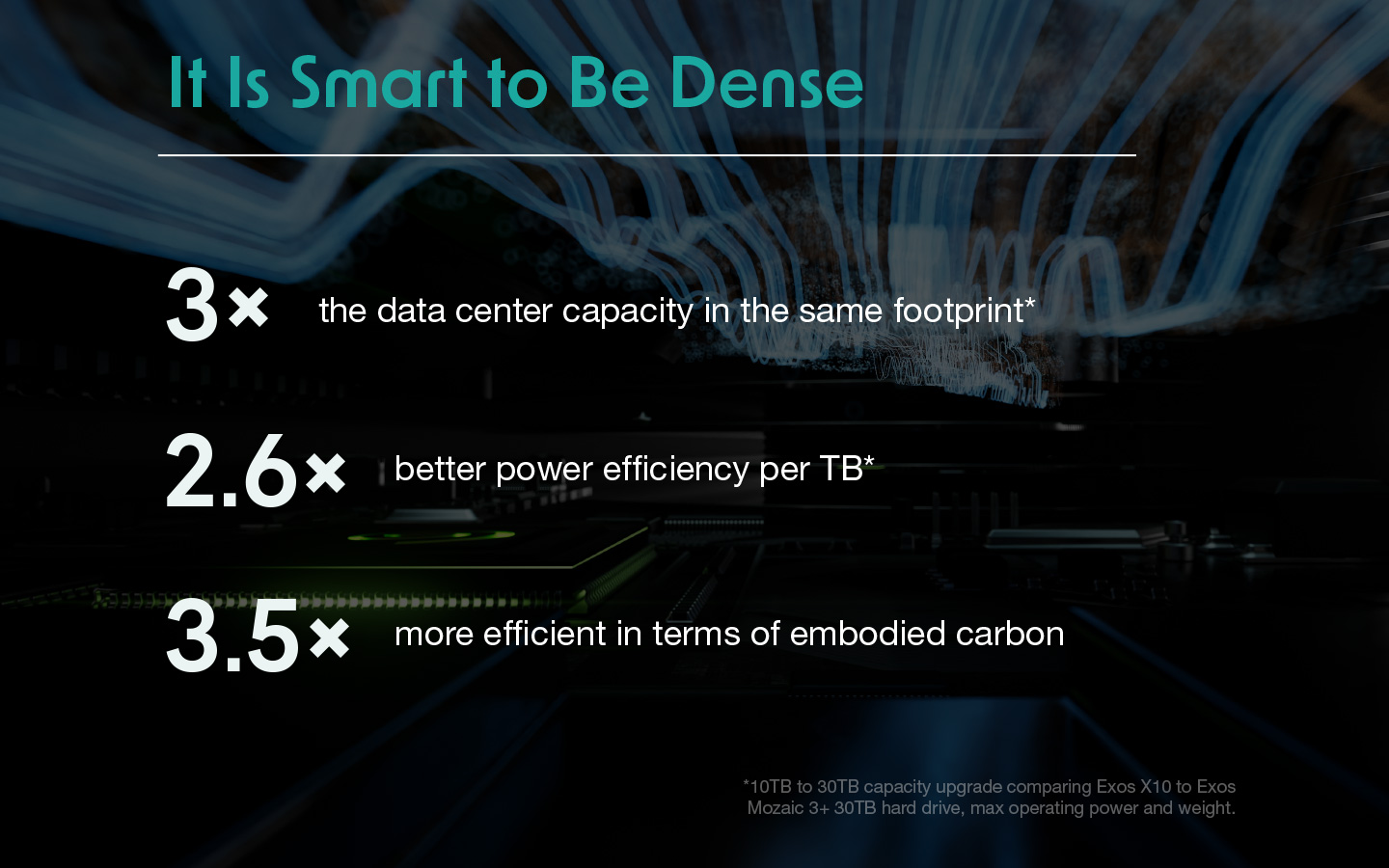
The transition to higher areal density drives means that, despite the projected 167% increase in total cloud data storage demand by 2028, the proportion of total data center power consumed by hard drives can drop from ~8% to ~3%. That is a 62% total reduction in energy consumption by storage infrastructure.
With 5TB per disk areal density advancements on the horizon, the same 10-disk drive will soon store 50TB and beyond—further multiplying data center capacity and power benefits.
How do denser Mozaic and Exos drives lower TCO and carbon together?
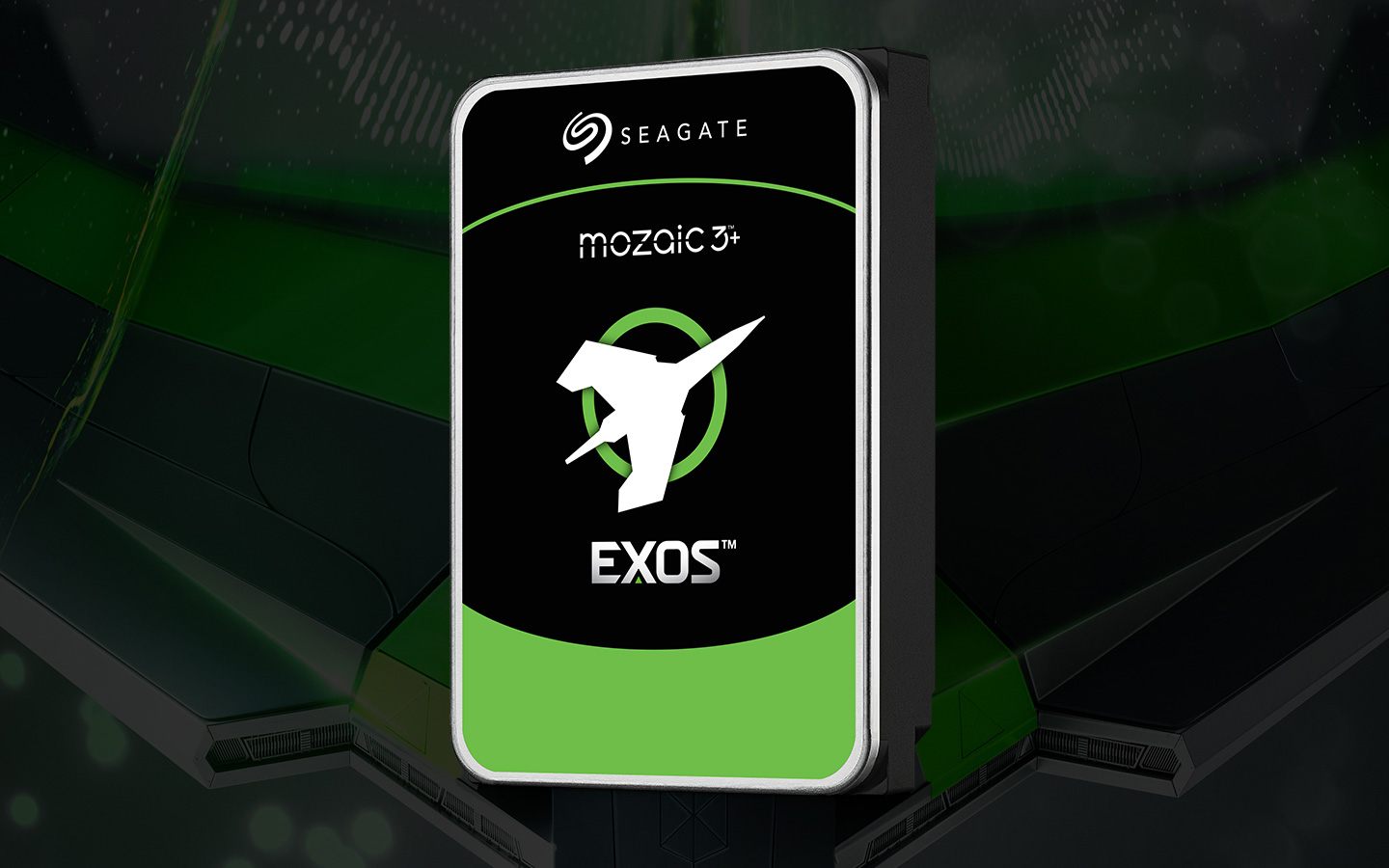
TCO and sustainability goals are not mutually exclusive—often they are one and the same. BlueAlly helps enterprises turn that insight into a deployment plan: higher-areal-density Mozaic and Exos configurations, life cycle extension, and circularity for responsible disposal.
We've developed a partnership with Seagate that lets us compete at the highest level on price and service. That translates into the widest range of in-stock products, fast shipping, and the advice of certified product experts—without the pain of premium pricing. If you need additional guidance in sourcing the right product, our team can bring you together with the presale engineering team.
What is the path to a sustainable datasphere?
The findings of this research highlight the role of industry-wide collaboration in supporting a sustainable datasphere. By working together, data centers, technology providers, component suppliers, and regulatory bodies can develop and implement innovative solutions that reduce energy consumption, minimize carbon emissions, and promote the efficient use of resources.
This includes adopting advanced cooling solutions, integrating renewable energy sources, extending the life cycle of storage equipment, choosing suppliers based on their sustainability commitments, and implementing circularity programs for the responsible disposal of components. Through collaboration and innovation, data centers can help create a datasphere that is scalable, efficient, and sustainable.
Greenhouse gases (GHG) that an organization emits from sources it owns or controls directly.
GHG deriving from an organization's purchase of electricity, steam, heat, or cooling.
GHG emissions originating from business operations by sources that are not directly owned or controlled by an organization.
The Decarbonizing Data report
Documentation behind the Decarbonizing Data findings and related sustainability research.
Decarbonizing data: frequently asked questions
Key findings from the Seagate report and how BlueAlly can help you act on them.
Decarbonizing Data is a Seagate Technology report based on a commissioned global study conducted by independent research firm Dynata, with fieldwork by global communications consultancy Current Global. The survey gathered responses from 330 data center professionals across 11 markets, all working for companies that manage at least 50 terabytes of storage. It reveals a critical gap in understanding data centers' sustainability challenges and how they affect the entire supply chain.
No. Working with customers has taught Seagate that TCO and sustainability goals are not mutually exclusive — often they are one and the same. At today's data centers, total cost of ownership and sustainability goals can be two sides of the same coin: longer hardware life, smarter infrastructure spend, less power usage, fewer raw materials, and smarter storage all reduce both cost and environmental impact.
Hard drives exhibit the least carbon footprint, both in total and on a per-TB basis, offering the most carbon-efficient storage solution. Hard drives also offer the most energy-efficient storage option and are the greenest storage media, followed by SSDs, with LTO 9 tape consuming the most power per unit of storage.
The transition to higher areal density drives means that, despite the projected 167% increase in total cloud data storage demand by 2028, the proportion of total data center power consumed by hard drives can drop from about 8% to about 3% — a 62% total reduction in energy consumption by storage infrastructure. Upgrading a 10-disk drive from 10TB to 30TB disks enables three times or more storage capacity in the same footprint, more than a 60% power reduction per TB, more than a 70% reduction in embodied carbon per TB, and 25% lower cost per TB.
Embodied carbon refers to the quantity of greenhouse gas emissions related to the upstream extraction, production, transport, bill of material, manufacturing, packaging, and distribution stages of a product's life cycle. Maintaining awareness of the embodied carbon of equipment and infrastructure (Scope 3) can help data centers identify opportunities to reduce their overall carbon footprint beyond just operational emissions (Scope 1 and Scope 2).
BlueAlly is an authorized Seagate reseller. Our solution architects help you model higher-areal-density Mozaic and Exos configurations, plan life cycle extension and circularity, and right-size deployments that reduce watts per terabyte, embodied carbon and total cost of ownership — with flexible procurement, CapEx or OpEx.
Model a lower-carbon, lower-TCO storage deployment
By adopting a comprehensive approach to sustainability, companies can balance the growing demands of AI and data center operations with environmental considerations. Request a complimentary review with a BlueAlly solution architect to model a higher-density, lower-carbon storage plan for your environment.
No-cost sustainability & TCO assessment
Higher-areal-density Mozaic & Exos configuration
Watts-per-TB and embodied-carbon projection
Life cycle extension & circularity planning
Talk to an Expert
with a BlueAlly Solution Architect